THE POWER OF BLUE

THE POWER OF BLUE. THE POWER OF ART
“Blue is the only color which maintains its own character in all its tones…it will always stay blue; whereas yellow is blackened in its shades, and fades away when lightened; red when darkened becomes brown, and diluted with white is no longer red, but another color – pink.” Raoul Dufy, French Fauvist Painter (1877–1953).
When you see the color blue, what do you feel? Whatever you feel, is it possible that feeling is universal? Or does the color blue mean different things to different people?
Blue is deeply symbolic. It represents the vast, unbounded sky and the depthless ocean, both of which serve as metaphors for the infinite nature of the universe. Hindu philosophy often revolves around the concepts of transcendence and detachment from the material world. Hindu deities, depicted with blue skin, are seen as manifestations of the infinite. Their blue color reminds worshippers that these gods are omnipresent and eternal, existing beyond the constraints of time and space. This color is a visual representation of the divine’s limitless power and presence.
Colors have minds of their own.

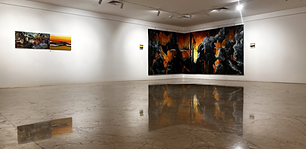
Arie Otten, series Blue Blood, 2024
Colors not only define what we see but have also been proven to produce feelings that can bring about a noticeable change in our mental state. Each color emanates particular signals and is a harbinger of certain emotions that affect our mental, physical and psychological state of being. Colors can dramatically affect moods, feelings, and emotions. The color Blue has been referred to as a magical hue that has the power to induce relaxation, tranquility and inspiration and even connect us to highest states of consciousness.
Blue has been used as a powerful tool in religious paintings throughout the history of western art. During the Middle Ages and Renaissance, blue was often used to evoke spiritual and emotional states in viewers, as well as to represent spiritual concepts.
By pouring different pure hues directly onto her canvases or cardboards, Colette Leinman could direct the flows of paint in ways that explored color relationships in new ways, with conceptual interference from elements such as line, shape, texture or form. She creates a lyrical abstraction to summon a memory of a place (related to Nature or mental state) through blue color. Leinman conceptualized the process of pouring the paint as a way of translating something internalized within her body into something externalized on the support. The painting almost entirely utilizes the various hues of blue standing out most profoundly as an abstract, rather than figurative, manifestation of the feelings.
Using a strict palette of colors with subtle shades and overlappings thereof, Arie Otten’s series of works is focused on emotional depth. Otten is always deliberately clear, even to the extent of suggesting an objectlike contour in each painting. His stroke is widely expressive as an independent, self-sufficient gesture. Actually, his blue abstractions are filled with subtleties, soft-spoken variations on the themes of passion, gentility, conflict, celebration, solitude, and many others, all eagedy romantic. Otten’s blue style has its heroic side, but it is intimate as well.

Colette Leinman, Flakes of light #19, 2024, Mixed media on cardboard, 40 x 100 cm