
In Search of Habitable Futures
Vernissage: 6 - 9 PM, 30 April, 2026
Schedule: 30 April - 18 May, 2026
Curated by: Sussan Fraser-Hughes, Rajul Shah and Siddhant Khattri
Artists: Frank Gude, Anna Tajak, Arie Otten, Carol Hartman, Colette Leinman, Pete Malmberg
Location: P.L. Deshpande Kala Academy, Mumbai, India
Vedica Art Studios and Gallery is pleased to announce the exhibition In Search of Habitable Futures, curated by Susan Fraser-Hughes, Rajul Shah, and Siddhant Khattri. The show presents, under the honorary patronage of The Weiss Fundacja Muzeum Wojciecha Weissa and Zofia Weiss Gallery in Poland, works by Frank Gude (Netherlands), Arie Otten (Netherlands), Carol Hartman (US), Pete Malmberg (US), Colette Leinman (French-Israeli Artist), and Anna Tajak (Poland). In Search of Habitable Futures investigates the enduring human pursuit of a place of dwelling that is materially sustaining, emotionally restorative, and ethically resonant, while questioning whether settlement or perpetual movement offers the most meaningful conditions for belonging.
The conceptual framework of the exhibition draws deeply from the psychological and aesthetic concerns articulated within German Expressionism, particularly the work of Franz Marc and Ernst Ludwig Kirchner’s painting The Street, Dresden (1908), alongside the writings of the German art historian Wilhelm Worringer. Worringer’s reflections on the “immense spiritual dread of space” and the “inner unrest” provoked by the outside world offer a critical lens through which the exhibition examines the modern condition of displacement and anxiety in relation to both urban and natural environments. Kirchner’s tense urban scenes register a nervous confrontation with metropolitan chaos, a condition that echoes within the present ecological and social climate explored throughout this exhibition. Just as, according to Kirchner, the urban world appear chaotic to moderns, so, too, according to Hartman, the current climatic conditions, in her piece titled Disruption, 2024, evoke immense dread of urban space fuelled by perverse consumption.
Frank Gude’s works suggest a mode of empathic engagement with the natural world, reflecting Worringer’s formulation of Einfühlung—the projection of human feeling into the surrounding environment. Through abstract yet naturalistic imagery, Gude humanizes nature as a living presence capable of restoring a sense of harmony against the anxieties of modern life. In contrast, Arie Otten’s geometric abstractions embody Worringer’s second formulation: abstraction as a psychological withdrawal from the unsettling flux of phenomena. His series Imagination in Blue (2021) reveals the modern desire to arrest instability through formal order. Otten’s compositions deploy the symbolic polarity of colors—blue representing severity and spirituality, yellow signifying gentleness and sensuality—to articulate tensions between containment and release, masculine rigidity and feminine flow. The anxious ruptures within his compositions register the heightened nervous stimulation experienced by urban individuals seeking structure amidst overwhelming spatial and psychological stimuli.
Pete Malmberg’s paintings extend Gude’s empathic vision into a vivid realism that celebrates the living rhythms of the natural world. Working from his environment in Iowa, Malmberg renders landscapes that pulse with organic vitality, acknowledging both the generative and chaotic dimensions of nature as a life-sustaining force. Anna Tajak, by contrast, constructs luminous, boundless landscapes that dissolve conventional distinctions between earth and sky. Through radiant fields of yellow, orange, and red, her works propose a synthesis between abstraction and realism reminiscent of Kandinsky’s assertion that abstraction and realism may ultimately converge. Meanwhile, Colette Leinman’s series The Eye of the Cyclone introduces the volatile forces of nature as both threat and revelation. Her works examine migration and displacement while acknowledging the paradox articulated by art historian Charles Haxthausen: that modern beauty may emerge as a “terrible beauty” born from tension, upheaval, and transformation. Together, these practices reveal diverse artistic responses to the modern condition of inhabiting spaces marked by instability, choice, and existential uncertainty.
In Search of Habitable Futures invites viewers to reflect upon the profound psychological conditions shaping contemporary habitation, including the “inner unrest” and “immense spiritual dread of space” described by Worringer in relation to modern experience. The exhibition considers whether the urban metropolis—with its rhythms of consumption, speed, and anonymity—cultivates a protective psychological detachment, echoing the “blasé attitude” described by sociological observers of modern cities, or whether a return to nature exposes humanity to an equally unsettling confrontation with chaos and unpredictability. By bringing together artistic practices that explore the tensions between belonging and displacement, knowledge and instinct, stability and flux, the exhibition encourages viewers to confront the paradoxical forms of alienation that shape contemporary life—prompting a deeper consideration of where and how one might truly dwell in the modern world.
SUPPORT
Arts University Plymouth, United Kingdom
.jpg)
HONORARY PATRONAGE
The Weiss Fundacja Muzeum Wojciecha Weissa, Kraków, Poland
Zofia Weiss Gallery, Kraków, Poland


ART MAGAZINE PARTNER
ArtonWorld.com, International Magazine of Art & Finance
Italy

CONTACT GALLERY
General:
Sale inquiry:
Siddhant Khattri
Partner
Pete Malmberg
Director
Address: Samudraa Building, Madh Island, Mumbai -400061, India
Zofia Weiss Gallery:
Works Exhibited

Frank Gude, Scenery, acrylic on canvas - 100 x 50 cm

Anna Tajak, It won't get any closer, 2025. Oil on canvas - 50.5 × 71 × 2 cm
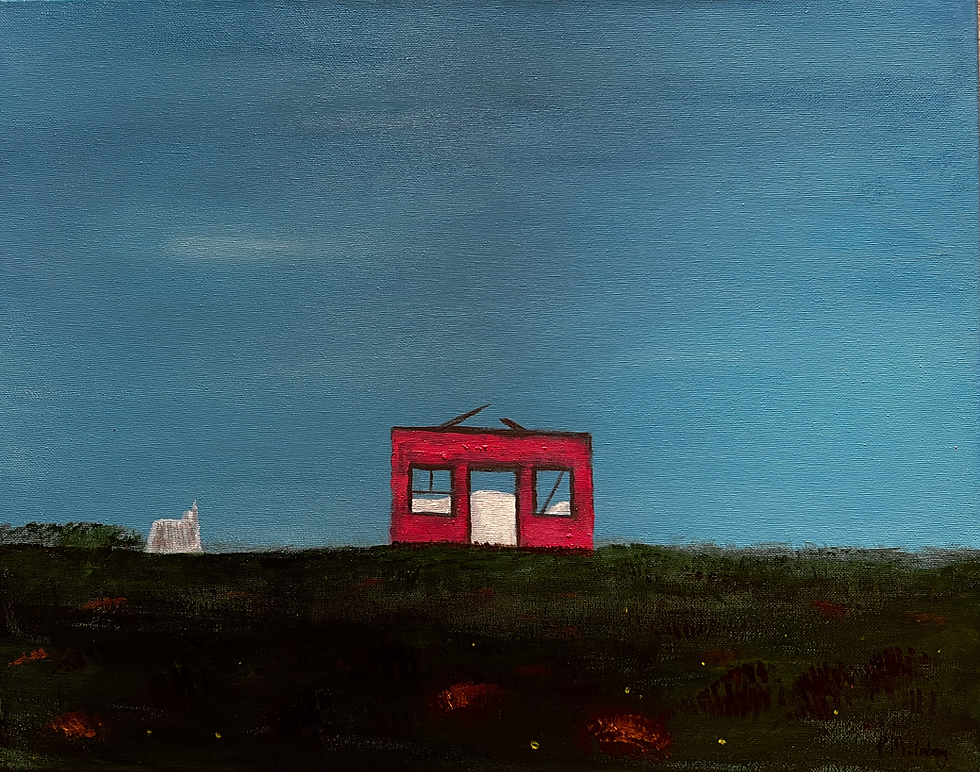
Pete Malmberg, Sinking and Collapsing, 2024. Acrylic on canvas - 9 x 12 in
Frank Gude, Scenery, acrylic on canvas - 100 x 50 cm